Wir durchsuchen 2.000.379 Objekte für Sie.



拍卖:10 天
作为 2026-05-28 16:50:49
HAER, ADOLF DE
1892 Düsseldorf–1945 Osnabrück
Title: "Mädchen mit Papagei".
Date: 1920.
Technique: Oil on canvas.
Mounting: Edges relined.
Measurement: 150 x 100 cm.
Notation: Signed and dated lower centre: A. de Haer 20. Titled, inscribed and signed verso upper centre: I Mädchen mit Papagei M 9000- Adolf de Haer.
Frame: Framed.
Provenance:
- - Anna Schønheider (purchased directly from the artist in Düsseldorf ca. 1920)
- Private collection, Norway (inherited)
- An impressive, large-scale painting from the artist’s powerful, expressive period around 1920
- A previously unknown major work by a leading figure of the ‘Young Rhineland’ movement
- The subject matter plays on the concept of the ‘exotic’: a central element of cultural life in the 1920s
- In the family’s possession since 1920 and never before exhibited publicly
A Painter Between the World Wars
Adolf de Haer, the son of a decorative painter, initially studied at the Düsseldorf School of Applied Arts on a scholarship—though only until his military service began in 1914. He subsequently turned to fine art painting; in the summer of 1917, he studied for several months under Adolf Hölzel and otherwise continued his artistic development as an autodidact.
In his hometown of Düsseldorf, Adolf de Haer was closely connected to the circle around the legendary “Mother Ey.” After the war, a new spirit swept through the Rhineland art metropolis: in 1919, de Haer became a co-founder of the artists’ association Das Junge Rheinland (“The Young Rhineland”), whose members included, among others, Max Ernst, Otto Dix, Walther Ophey, and his closest friends Gert Wollheim and Otto Pankok. The painter also became active in the Aktivistenbund 1919 (“Activists’ League 1919”).
During this period, de Haer created his Cubist-Expressionist paintings, formally related as well to Futurism and Russian-French Rayonism. It was the new visual language of the age—the German avant-garde around 1920 aspired to internationalism. In 1921, Adolf de Haer held his first solo exhibition at the gallery Junge Kunst – Frau Ey in Düsseldorf.
In the second half of the 1920s, however, his style changed. He abandoned the crystalline-expressionist rendering of light and space and turned instead toward a late-Impressionist visual language. Exhibition participations and public acquisitions documented Adolf de Haer’s growing success. In the 1930s, he found himself in the peculiar position that his contemporary portraits, nudes, and floral still lifes appeared acceptable to the authorities, while his expressive early work of the 1920s was denounced as “degenerate.”
The painter lived in Kaiserswerth, but in 1944 was nevertheless conscripted into military service once more. He died at the age of fifty-two in a military hospital in Osnabrück.
Five Women with a Parrot
Five young women surround a parrot—more precisely, a Major Mitchell’s cockatoo. At first glance, the five women appear strikingly similar: their black hair and large almond-shaped eyes correspond to one another, as does their uniform grey-white clothing with pronounced folds. Arranged in a pyramidal composition, the women are initially perceived as a homogeneous group within the large-format painting.
Yet their hairstyles and hairlines, and above all their facial expressions and gestures, individualize and characterize the young women, placing them in subtle relation to one another. The bird at the centre does not command the undivided attention of the beauties: two of the women turn toward the exotic creature with joyful naïveté, while the remaining three, positioned on the right side of the composition, observe them while also cautiously watching one another.
The prismatic parallel structures in the background reveal little about the surrounding environment. Are rays of sunlight striking the compact group from the upper left edge of the painting? Might curtains—or perhaps tree trunks—be suggested along the right margin? In the foreground, flowers with sharply serrated leaves visually echo the crystalline angularity of the women’s pleated garments.
Could these be five members of a cabaret troupe, performing in matching costumes? Cockatoos and parrots were highly fashionable in the 1920s, and not only the legendary Berlin nightclub Kakadu adorned itself with living birds.
A Rediscovery within de Haer’s Oeuvre
Human figures—especially women—accompanied by animals constitute a recurring motif in Adolf de Haer’s still only fragmentarily known but remarkably powerful early work. A group of three women with a dog (fig. 1), dated around 1919, is directly connected to the present painting, not least through the striking clothing of the female figures. Additional graphic works dated 1920, bearing titles such as Talking with Fish or Girl with Fish, belong to the same thematic series.
Girl with Parrot represents a small art-historical sensation: acquired directly from the artist, it has remained inaccessible to the public ever since. In the rediscovery and reassessment of Adolf de Haer’s oeuvre, this painting—dated 1920 and originating from the artist’s avant-garde phase—may prove to be a significant element in understanding his early work.
Alexandra Bresges-Jung
Estimated shipping costs for this lot:
The lot is unsuitable for parcel shipping. Transport only by shipping company after consultation following the auction.
additional shipping insurance
Shipping insurance
up to total invoice amount of 25,000 Euros: max. 41.65 Euro
over a total invoice amount of 25,000 Euros: 1.8 o/oo
USA by individual arrangement after the auction.
#Adolf de Haer #Rhenish Expressionism #Germany #19th Century Paintings #1920s #Figure / Figures #Painting #Modern Art.
This lot will be sold under standard taxation (Condition of Sale §V5.1)
In accordance with §26 UrhG (German Copyright Act), VAN HAM is obliged to pay a statutory resale royalty on the sale proceeds of all original works of fine art and photography whose authors have not been deceased for 70 years prior to the end of the calendar year of the sale. The buyer shall contribute 1.5% of the hammer price to this fee.


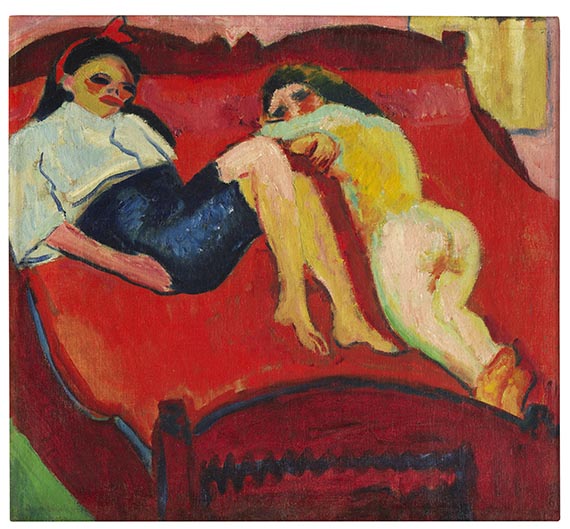


 Hermann Max Pechstein
 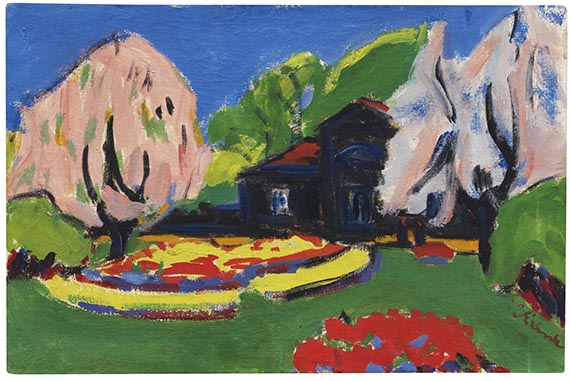 Ernst Ludwig Kirchner
 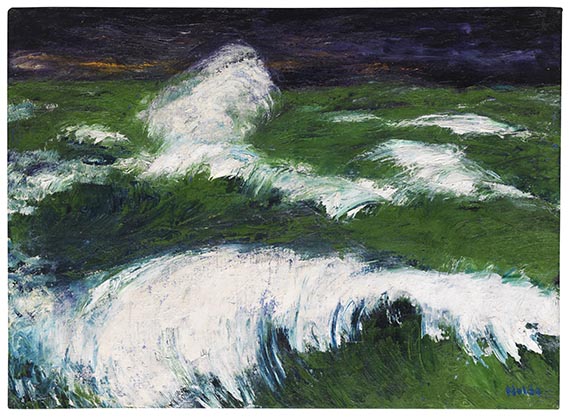 Emil Nolde
 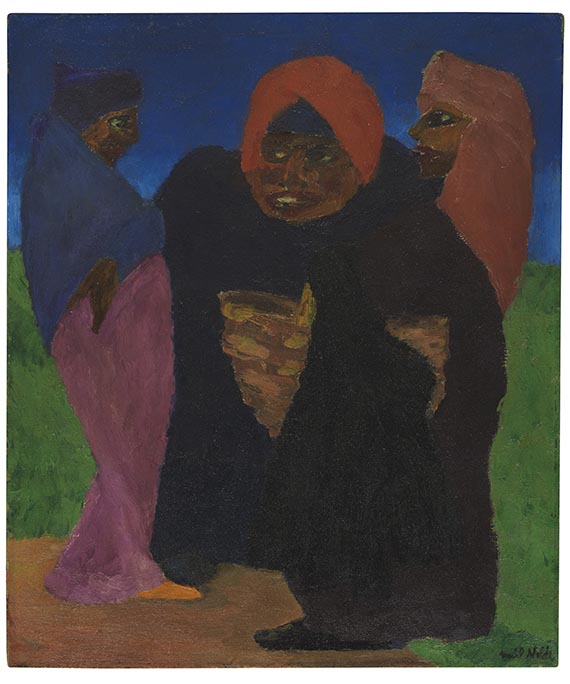 Emil Nolde
  Ernst Ludwig Kirchner
  Hermann Max Pechstein