Wir durchsuchen 2.060.731 Objekte für Sie.



拍卖:20 天
作为 2026-04-22 10:50:50
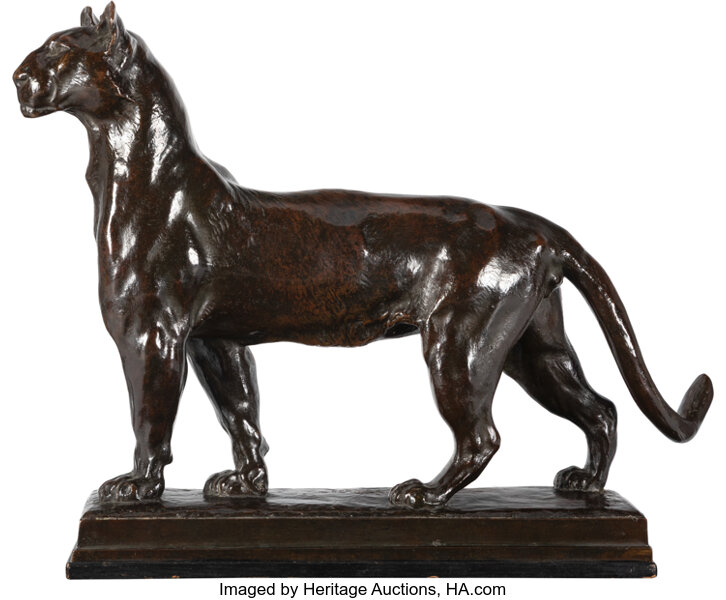
Alexander Phimister Proctor (American, 1860-1950) Puma (No. 2), modeled 1897 Bronze with dark brown patina 11-5/8 inches (29.5 cm) high on a 5/8 inch (1.59 cm) high wooden base Inscribed on base: A PHIMISTER / PROCTOR / 1897 Stamped along base with foundry cartouche: GORHAM CO FOUNDERS / QAHZ PROVENANCE: Conner Rosenkranz, New York; Private collection, Jackson Hole, Wyoming, and Scottsdale, Arizona, acquired from the above, 1990s; Acquired by the present owner from the above. LITERATURE: P.H. Hassrick, Wildlife and Western Heroes: Alexander Phimister Proctor, Sculptor, Fort Worth, Texas, 2003, pp. 128-29, illustrated (another example). Alexander Phimister Proctor's pumas are among the most iconic sculptural images associated with Prospect Park in Brooklyn, their commanding presence firmly embedded in the visual identity of the site, and across the borough's entire public landscape. After receiving the Rinehart Scholarship for studies abroad in Paris, in the fall of 1896 and through to the summer of 1898, Proctor worked on this important commission. The opportunity came on the heels of a generous recommendation from Proctor's colleague, Stanford White, who had just completed a pair of towering pedestals to frame the park's entryway. The results of that commission were Proctor's Pumas, installed as a pair at Prospect Park's southern entrance, where their commanding presence quickly became an enduring symbol of the site. Peter H. Hassrick describes them as, "sleek and noble, these two pumas have been arrested in a moment of defiant confrontation with some unseen force," he continued, "Perhaps their superior air reflected Proctor's own sense of nature's primacy. These stately feline sentinels, regarding the city and its inhabitants before them, assert nature's power and ultimate invincibility" (Wildlife and Western Heroes: Alexander Phimister Proctor, Sculptor, Fort Worth, Texas, 2003, p. 129). Modeled in 1897 and copyrighted in 1899, the present work is one of the two bronze reductions Proctor modeled after the Prospect Park pumas—titled subsequently, Puma (No. 1) and Puma (No. 2). The artist was able to translate his large-scale public commission into a more intimate format, without sacrificing its sculpturesque authority. Further modifications to these Pumas allowed each small bronze to remain unique from the monumental commissions, which included slight changes to the stances of the pumas—while both monuments stand upright, Puma (No. 1) was reimagined to show the puma's ears pinned back, leading with his right leg; while Puma (No. 2), the model for the present work, was portrayed as a female, her ears perked up, leading with the opposite left leg forward. As demonstrated here, the feline stands alert, its body taut with restrained energy, head raised and ears forward, suspended in a moment of heightened awareness. Proctor claimed that the puma bronze reductions were based on direct observation of animals at the Paris zoo in 1896 and 1897. That is made clear by the artist's obvious commitment to anatomical accuracy but these bronzes are also revealing of a stylized treatment he refined, one inspired by classical sources as well as Egyptian stone sculptures he would have encountered as a student visiting the Metropolitan Museum of Art. Through both its monumental origin and its refined reduction, Puma (No. 2) encapsulates Proctor's mastery of animal sculpture and his ability to imbue natural subjects with symbolic resonance. The Prospect Park pumas became iconic visual markers of Brooklyn's civic identity, the animals' presence reinforcing the relationship between urban space and the enduring forces of the natural world. While the total edition size of Puma (No. 2) is presently unknown, a total of six casts have so far been located. The present work is believed to be one among only two casts in private hands, the second was formerly recorded in the collection of Gifford Proctor of Wilton, Connecticut. The remaining located casts can be found in the public collections of the North Carolina Museum of Art, Raleigh; Glenbow Museum, Calgary, Alberta, Canada; The Brooklyn Museum, New York; and the National Gallery of Canada, Ottawa. HID12401132022 © 2026 Heritage Auctions | All Rights Reserved www.HA.com/TexasAuctioneerLicenseNotice
Conner Rosenkranz, New York; Private collection, Jackson Hole, Wyoming, and Scottsdale, Arizona, acquired from the above, 1990s; Acquired by the present owner from the above.
Condition report available upon request.