Wir durchsuchen 2.015.063 Objekte für Sie.



拍卖:6 天
作为 2026-05-18 10:09:08
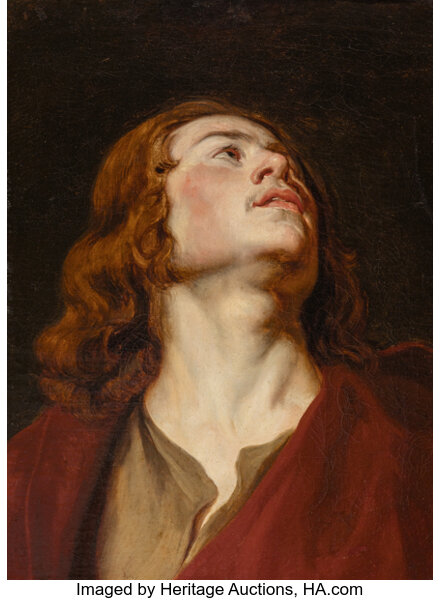
Jacob van Oost the Elder (Flemish, 1603-1671) Saint John the Evangelist, after Peter Paul Rubens and Anthony van Dyck Oil on canvas 22 x 16-1/2 inches (55.9 x 41.9 cm) PROVENANCE: Kunsthandel P. de Boer, Amsterdam; Jean Moust, Bruges; Dorotheum, Vienna, September 6, 2020, lot 265 (as workshop of Anthony van Dyck); Private collection, Los Angeles. This striking bust-length depiction of Saint John the Evangelist—among Christ's most beloved disciples—is by Jacob van Oost the Elder, the leading painter of seventeenth-century Bruges. Renowned for his gifts as a portraitist, van Oost received numerous commissions for large-scale altarpieces in his native city, where his acute sense of characterization enlivens his historical compositions. Born into a prosperous Bruges family, he trained with his brother Frans and was admitted to the Guild of Saint Luke in 1619, achieving master status in 1621. That same year, he departed for Italy, spending approximately five years in Rome, where he absorbed the influence of Caravaggio and his follower Bartolomeo Manfredi. Although no works from this Italian period can be securely identified, paintings executed after his return to Bruges in 1628 reveal a clear engagement with Caravaggesque tenebrism, naturalistic figures, and related subject matter. Around 1650, van Oost's style shifted in response to developments in Antwerp painting, particularly the work of Peter Paul Rubens and Anthony van Dyck. His later works are marked by increased emotional intensity, more complex spatial arrangements, and a richer, more luminous palette indebted to Venetian art. In this phase, his paintings also reflect the influence of Federico Barocci and Correggio, in addition to van Dyck, whose compositions he occasionally adapted or copied. The present work offers a powerful example of van Oost's engagement with Rubensian invention. The head and neck of Saint John derive from the figure in the right wing of Rubens's 1618 funerary triptych for Jan Michielsen and Maria Maes, The Lamentation over the dead Christ, formerly in the Onze-Lieve-Vrouwenkerk, Antwerp, in which the Evangelist appears at three-quarter length, holding a Gospel book and turning sharply upward toward the eagle of divine inspiration (now in the Royal Museum of Fine Arts, Antwerp, no. 300-304). Notably, van Oost does not appear to have worked directly from Rubens's original but rather from a secondary source: a version attributed to Anthony van Dyck (National Museum, Norway, no. NG.M.01355), a close collaborator of Rubens. That painting isolates the head and neck and introduces compositional features absent from the prototype, including the split at the nape of the shirt—an element retained in the present work. The overall framing and reduction of the figure likewise correspond more closely to the version associated with van Dyck than to Rubens's altarpiece. A close comparison between these works reveals van Oost's independent reinterpretation. He subtly adjusts the orientation of the head, turning it further to the side, whereas both Rubens and van Dyck present a more frontal view that exposes more of the left cheek. His palette is notably warmer, with pronounced red undertones, and his handling of light and shadow is more emphatic. The resulting chiaroscuro intensifies the modeling, accentuating the torsion of the neck and lending the figure a heightened sense of physicality and presence. While such processes of adaptation were common among Flemish artists of the period, van Oost's treatment is distinguished by its structural clarity and robust modeling. His ability to translate a Rubensian motif into a more concentrated and psychologically immediate image underscores both his technical skill and his interpretive independence. He served repeatedly as an officer of the Bruges Guild of Saint Luke. HID12401132022 © 2026 Heritage Auctions | All Rights Reserved www.HA.com/TexasAuctioneerLicenseNotice
Kunsthandel P. de Boer, Amsterdam; Jean Moust, Bruges; Dorotheum, Vienna, September 6, 2020, lot 265 (as workshop of Anthony van Dyck); Private collection, Los Angeles.
Lined canvas. Framewear along left edge. Fine craquelure throughout.
Under UV: varnish fluoresces green throughout. Small areas of inpaint along upper edge, with inpainting around small areas of raised craquelure on figure;s chest, proper left. Additional line of inpaint along diagonal repair to canvas along right edge.
Framed Dimensions 29 X 23 Inches