Wir durchsuchen 2.049.810 Objekte für Sie.



拍卖:6 天
作为 2026-05-18 10:09:08
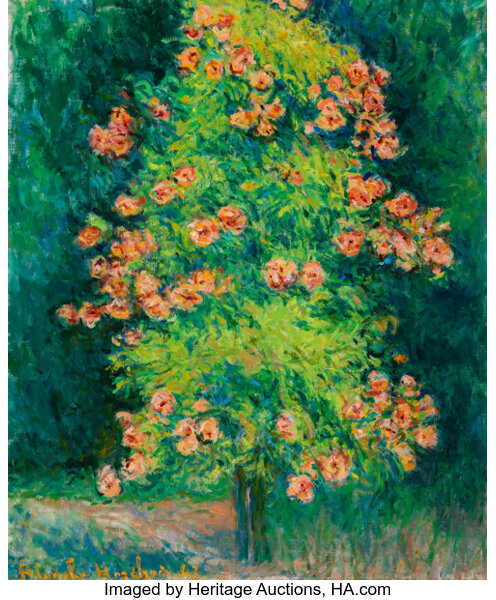
Blanche Hoschedé-Monet (French, 1865-1947) Le bignonia dans le jardin, 1947 Oil on canvas 24 x 19-3/4 inches (61.0 x 50.2 cm) Signed lower left: Blanche Hoschedé 47 Signed, inscribed, and dated on the verso: B. Hoschedé / le bignonia le jardin / 1947 PROVENANCE: The artist; Private collection, by descent; A. Legall, Paris, France; P. Bertrand, Oakland, California, acquired from the above; Acquired by the present owner from the above, 1999. The work will be included in the catalogue raisonné of Blanche Hoschedé Monet currently being prepared by Philippe Piguet. The lot is accompanied by his certificate of authenticity under the reference BHM 13-1. After the 1914 death of her husband, Jean Monet, Claude Monet's son, Blanche Hoschedé-Monet returned to Giverny, taking a break from painting, and devoting herself to running her stepfather's household. In 1926, Monet died at eighty-six, leaving the then sixty-year-old Blanche entrusted with a key role in the management of the artist's remaining works and the home and gardens at Giverny, which compelled her renewed artistic activity and to an active social life, welcoming Paul Signac, Pierre Bonnard, and Maximilien Luce (see lot 69114) and other members of the public eager to view the famous estate. In this period, her fame grew with the Galerie Durand-Ruel acquiring her paintings for between 1,000-3,000 francs (versus 100-300 francs the years before). In November 1927, Galerie Bernheim-Jeune hosted Blanche's first solo show, followed by a second in 1931. Through the decade, she also exhibited several times at the Salon des Indépendents among other national exhibitions (N. Bondenel, "The Last of the Impressionists," Blanche Hoschedé-Monet, In the Light, ed. H. S. Pearce, exh. cat., Eskenazi Museum of Art, Indiana University, 2025, p. 27-31). By the 1940s, when Le bignonia dans le jardin was painted, Blanche's reputation was secured. Her later works show both the influence of Monet and her very personal vision, particularly as the Impressionist movement was making way for the various schools of Modernism. As vibrantly illustrated by Le bignonia dans le jardin, Blanche became ever more focused on garden views, where the canvas is filled with bright flowers and lush vegetation, built of broader, more fluid brushwork than her late nineteenth century technique (see lot 69020). Here, Blanche evocatively captures the vigorously growing, climbing plant that covers arbors, fences, and even trees—one that Monet cultivated throughout Giverny. Blanche's devotion to the garden may have been influenced by World War II, an era when Giverny was bombed and the artist held the estate from requisition by the German army (Bondenel, pp. 31-32, 36). Through the post-war years Blanche rarely left Giverny, and preferred to paint on her easel in the garden or at home— where her artistic spirit, her family's legacy, and painting the beauty of nature continued to flourish. HID12401132022 © 2026 Heritage Auctions | All Rights Reserved www.HA.com/TexasAuctioneerLicenseNotice
The artist; Private collection, by descent; A. Legall, Paris, France; P. Bertrand, Oakland, California, acquired from the above; Acquired by the present owner from the above, 1999.
Unlined.
Under UV: there is no evidence of restoration. Original blue pigments which fluoresce under UV light, particularly in top left corner, but the fluorescence appears to arise from type of pigment used, not restoration.



 Blanche Hoschedé-Monet