Wir durchsuchen 2.063.505 Objekte für Sie.



拍卖:6 天
作为 2026-05-18 10:09:08
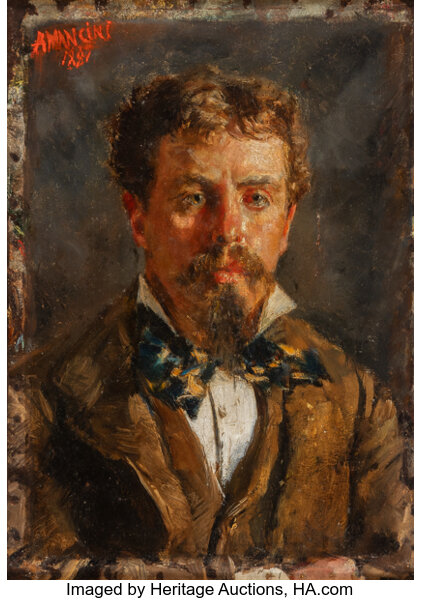
Antonio Mancini (Italian, 1852-1930) Ritratto di uomo (Portrait of a man), 1881 Oil on canvas 15-3/4 x 12 inches (40.0 x 30.5 cm) Signed and dated upper left: A Mancini / 1881 Property from the Dr. Sheldon G. and Irma H. Gilgore Collection of Italian Art 1850-1925 PROVENANCE: Van Ham Kunstauktionen, Cologne, December 2, 2000, lot 2103; Christie's, London, April 5, 2001, lot 53, as Portrait of a young gentleman wearing a white shirt, cravat and brown waistcoat and jacket; Acquired from the above. LITERATURE: Ottocento: Catalogo dell'arte italiana dell'Ottocento, no. 30, Mondadori, Milan, 2001, p. 279; C. Virno, Antonio Mancini: catalogo ragionato dell'opera, vol. I, Rome, 2019, p. 216, no. 268, illustrated. Within the late nineteenth-century Neapolitan artistic community, Antonio Mancini was considered a phenomenon, possessing legendary skill that led some to call him a "conjurer" or "magician." Others viewed him differently, referring to him as il pittore pazzo, the "crazy painter." Born in Rome in 1852, his years were spent in Naples, where his artistic career began around 1868 with his emergence as a gifted figure painter known for his realistic depictions of Neapolitan scugnizzi (street urchins). In the mid-1870s, Mancini traveled to Paris, where he connected with Edgar Degas and édouard Manet, among others, and secured a contract with the powerful French gallery Goupil & Cie. Yet Paris also proved troubling for the artist, and the works he submitted to the Exposition Universelle of 1878 were largely ignored—in contrast to the accolades earned by Giuseppe De Nittis (see lots 69080) and Vincenzo Gemito (see lots 69086-90), with whom Mancini had a complicated friendship. Depressed and in debt, Mancini returned to Naples and, over the next few years, continued to struggle with both his career and his mental health, oscillating between periods of compulsive activity and apathy, even resorting to selling his paintings door to door (U. W. Hiesinger, Antonio Mancini: Nineteenth-Century Italian Master, exh. cat., Philadelphia Museum of Art, 2007–2008, pp. 1–3, 39–44). Ritratto di uomo was painted during this tumultuous yet brilliant period, which culminated on October 12, 1881, when, at the age of twenty-nine, Mancini was committed to a mental hospital. As part of his treatment, he was allowed to paint and draw, filling notebooks with ideas for compositions and producing portraits of the director, fellow patients, nurses, and guards, as well as a powerful series of self-portraits. While the exact date in 1881 when Ritratto di uomo was painted remains unknown, as does the identity of the enigmatic sitter, Cinzio Virno suggests that it may have been completed in the months leading up to Mancini's institutionalization—perhaps before or by May 1881—based on a note in which Mancini refers to a portrait and asks: "Would you like your portrait redone from head to toe, Professor Lepre?" (as translated and quoted in Virno, p. 216, Virno adds the note may reference another painting, Ritratto dell'orefice Guglielmo Marchi, no. 270) painted the same year). Dr. Lepre, an anatomy professor at the Istituto di Belle Arti and a neighbor of the Mancini family, had previously assisted the artist with some form of treatment (Hiesinger, p. 42). Regardless of the sitter's identity, the work aligns with related paintings from this period, combining close, almost forensic observation with experimental technique. Through subtle shifts of form and tone, Mancini captures the nuanced expression of his subject, while broader applications of ruddy brown paint construct the jacket, which appears to dissolve into the dark background. The sitter is rendered with remarkable precision and individuality; the tension between carefully described and fragmented features creates a sense of immediacy and psychological intensity that is both recognizable and elusive. Works such as Portrait of a Man illustrate Joseph Stella's recollection—he knew Mancini in Rome—that "the preoccupation that most stirred [Mancini] was the most exact reproduction of the truth" (Irma B. Jaffe, Joseph Stella, Cambridge, MA, 1970, pp. 143–44, as quoted in Hiesinger, p. 39). HID12401132022 © 2026 Heritage Auctions | All Rights Reserved www.HA.com/TexasAuctioneerLicenseNotice
Van Ham Kunstauktionen, Cologne, December 2, 2000, lot 2103; Christie's, London, April 5, 2001, lot 53, as Portrait of a young gentleman wearing a white shirt, cravat and brown waistcoat and jacket; Acquired by the present owner from the above.
Lined canvas. Scattered areas of craquelure. Light surface dust. Three-quarter-inch abrasion to right of figure's face, not affecting figure.
Under UV: varnish fluoresces green. Areas of inpainting in dark background along left and right edges.
Framed Dimensions 22.5 X 17.75 Inches